How to Host the Ultimate Water Trampoline Party: Step‑by‑Step Checklist for Setup, Safety, Supplies & Games
Introduction
Planning a water‑filled celebration demands careful coordination, yet the reward is an unforgettable experience for guests of all ages. This guide explains how to select the right trampoline, prepare the site, ensure safety, and organize engaging games. By following each step, one can transform a calm lake or backyard pool into a vibrant floating arena that encourages active play and social interaction.
The instructions balance thoroughness with accessibility, allowing hosts with moderate experience to execute a professional‑grade event. Readers will learn how to evaluate product features, manage logistics, and create a safe environment without excessive expense. The result is a party that feels both spontaneous and meticulously planned.
What You’ll Need
- YUMPIE 10FT Water Trampoline – $199.99, 4.2‑star rating, supports 550 lb.
- Island Hopper 13' Water Bouncer – $1,149.00, 3.9‑star rating, supports 500 lb.
- Island Hopper 15' Water Trampoline – $3,499.00, 5‑star rating, supports 600 lb.
- TKLoop 10FT Inflatable Water Trampoline – $218.00, 4.4‑star rating, supports 350 lb.
- COOLWAVE Inflatable Water Trampoline – $349.00, 4.3‑star rating, supports up to 550 lb.
- Heavy‑duty anchor ropes or weighted anchors (e.g., sandbags, cinder blocks)
- Water‑proof first‑aid kit and flotation devices
- Portable speaker, waterproof Bluetooth speaker for music
- Coolers, reusable cups, and snack trays
- Sunshade or pop‑up canopy for shade
Step 1: Choose the Ideal Water Trampoline
Selecting a trampoline that matches the size of the gathering and the water conditions is essential. For small families or lakeside picnics, the YUMPIE 10FT Water Trampoline offers a compact footprint, octagonal stability, and a price under $200, making it an economical choice. Its reinforced PVC mesh and high‑density net provide a bouncy surface that supports up to 550 lb, suitable for two adults or several children simultaneously.
When the party expects larger groups, the Island Hopper 13' Water Bouncer delivers a generous surface area and six D‑rings for anchoring, though it costs more than $1,000. Its spring‑less design with foam padding reduces impact forces, which is advantageous for younger children.
For commercial‑grade events, such as resort rentals or summer camps, the Island Hopper 15' Water Trampoline combines a steel frame, springs, and a heavy‑duty PVC skin, providing the most powerful bounce and a 600 lb capacity. This model is ideal when a high‑energy experience is desired.
If budget constraints are moderate and quick setup is a priority, the TKLoop 10FT Inflatable Water Trampoline includes an electric pump that inflates in under seven minutes, and its puncture‑proof PVC offers durability at $218.
Finally, the COOLWAVE Inflatable Water Trampoline stands out for its dual‑function design: it can be flipped into a hammock for lounging, adding versatility for mixed‑age groups.
Step 2: Prepare the Site and Anchor Points
Identify a calm, shallow area of the lake or pond where wind and current are minimal. Mark a perimeter of at least two feet around the intended trampoline location to allow safe entry and exit. Use a measuring tape to verify that the water depth is between 3 and 5 feet, which provides enough buoyancy while keeping users within reach of rescue equipment.
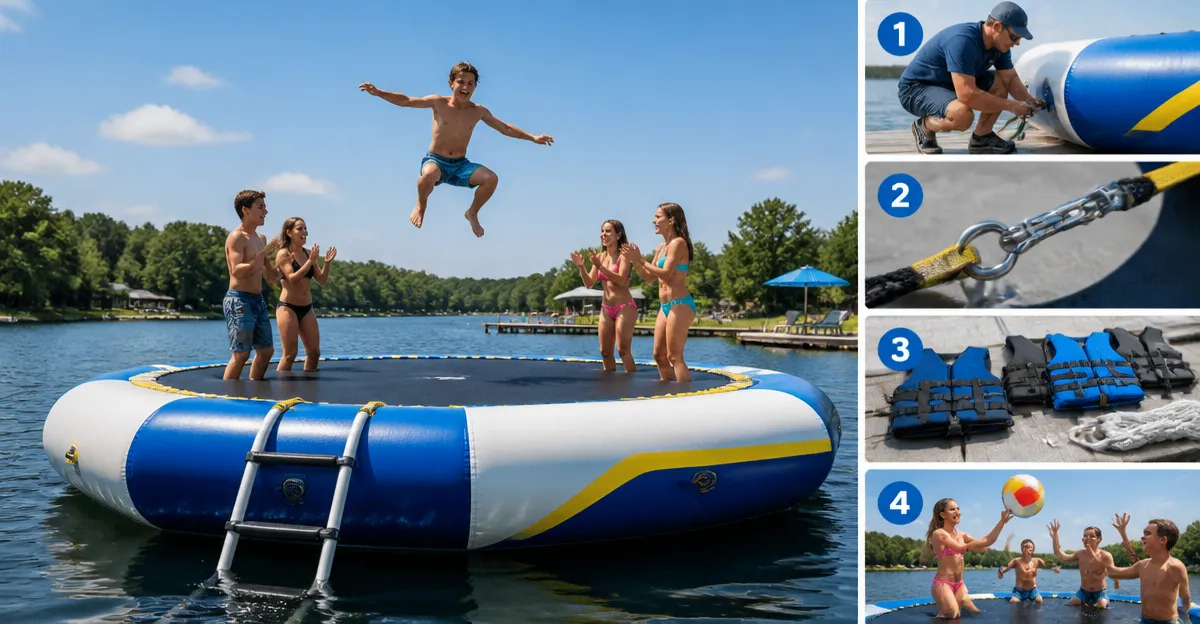
Place weighted anchors—such as sandbags, concrete blocks, or cinder blocks—at each D‑ring or rope loop on the trampoline. The YUMPIE model includes D‑rings, while the Island Hopper series provides six or seven D‑rings for secure mooring. Position opposite anchors directly across from the rope ladder to prevent the platform from flipping when users climb.
Run a sturdy rope from each anchor to the corresponding D‑ring, then tighten using a simple bowline knot. Check tension by pulling gently; the trampoline should remain level without excessive sagging. This step reduces drift and maintains a stable jumping surface throughout the party.
For added safety, lay a floating safety net or perimeter barrier if children under five will be present. The net should be positioned at least one foot away from the trampoline edge to catch accidental falls without restricting movement.
Step 3: Inflate and Secure the Trampoline
Unpack the chosen trampoline and locate the electric pump (included with YUMPIE, TKLoop, and COOLWAVE models). Connect the pump to a 110‑120 V outlet and attach the hose to the inflation valve. Inflate the unit until the surface feels firm; over‑inflation can stress seams, while under‑inflation reduces bounce.
For the Island Hopper 13' and 15' models, a standard air compressor is recommended because of the larger volume. Begin inflating the outer ring first, then the inner net, following the manufacturer’s instructions. The 13' Bouncer typically requires ten minutes, while the 15' Trampoline may take up to fifteen minutes.
After inflation, inspect all seams for leaks using a soapy water solution. Bubbles indicate escaping air; apply the supplied repair patch if needed. Once sealed, attach the rope ladder to the designated hook, ensuring the ladder hangs on the side opposite the primary anchor.
Finally, secure the trampoline with the previously positioned anchors. Verify that the platform remains level by stepping onto the edge lightly; a stable platform will not rock excessively. This verification step is crucial before allowing guests to jump.
Step 4: Set Up Safety Zones and Accessories
Create a clear safety zone by placing inflatable pool noodles or floating rings around the trampoline’s perimeter. These markers alert swimmers to the active area and provide a soft barrier should someone drift too close.
Distribute life jackets or personal flotation devices to all participants, especially non‑swimmers and children. Position a waterproof first‑aid kit on a dry side table, and assign a designated “water safety monitor” who remains near the trampoline at all times.
Install the four reinforced handles included with the TKLoop and COOLWAVE models to assist users when climbing onto the platform. Handles also serve as convenient grab points for rescuers in an emergency.
If the event extends into late afternoon, set up a pop‑up canopy or shade sail adjacent to the trampoline. This provides a dry area for changing, storing personal items, and offering a break from sun exposure.
Step 5: Organize Games and Activities
Begin the party with a warm‑up circle where participants stretch and practice safe entry techniques. Then introduce a series of games that utilize the trampoline’s bounce and water environment.
- Water Dodgeball: Use soft, water‑filled balloons; players must bounce and dodge while remaining on the trampoline.
- Float‑and‑Catch: One player throws a floating ball; teammates must jump to catch it without falling.
- Hammock Relaxation Relay: For the COOLWAVE model, flip the trampoline into a hammock; teams race to lounge for a set time before returning to bounce.
- Timed Jump Challenges: Measure how many jumps each participant can complete in 30 seconds; record scores for a friendly competition.
Rotate activities every 20 minutes to maintain excitement and prevent fatigue. Provide water‑safe music through a waterproof Bluetooth speaker to create an energetic atmosphere.
Step 6: Manage Refreshments and Comfort
Set up a hydration station with large coolers filled with ice water, electrolyte drinks, and fruit slices. Encourage guests to drink regularly, especially after vigorous jumping.
Offer light snacks such as granola bars, fruit kebabs, and trail mix on a floating tray or a nearby table. Keep food away from the water surface to avoid contamination.
Arrange a changing area with towels, sunscreen, and spare swimwear. A portable shower or hose can rinse off sand and chlorine after the party, enhancing comfort for guests leaving the water.
Tips & Pro Tips
- Anchor the trampoline on opposite sides of the ladder to prevent flipping when users climb.
- Inspect the inflatable for punctures before each use; small leaks can worsen quickly under weight.
- Use the rope ladder only when the trampoline is fully inflated; a partially inflated platform can become unstable.
- Assign a “bounce monitor” to watch for unsafe behavior, such as somersaults that may cause injury.
- Consider adding water slide attachments to the YUMPIE model’s D‑rings for extra excitement.
Troubleshooting
| Problem | Possible Cause | Solution |
|---|---|---|
| Trampoline drifts or flips | Insufficient anchoring or uneven weight distribution | Re‑tighten anchor ropes, add additional weighted anchors, and ensure ladder is opposite an anchor. |
| Air loss after a few hours | Small puncture or valve leak | Apply repair patch from kit, re‑inflate, and test with soap solution. |
| Ladder is difficult to climb | Ladder positioned on the side that faces wind or water currents | Reposition ladder to the leeward side and ensure it is fully extended. |
Conclusion
By selecting an appropriate water trampoline, preparing a safe anchored site, and organizing engaging games, one can host a memorable water‑filled celebration that balances excitement with safety. The step‑by‑step checklist ensures that every detail—from inflation to refreshments—is managed efficiently, allowing the host to focus on enjoying the festivities alongside guests.
With the right tools and careful planning, the ultimate water trampoline party becomes a repeatable event that can be adapted for birthdays, family reunions, or community gatherings. One is encouraged to apply the guidelines herein and create a splash‑worthy experience that will be talked about for seasons to come.
Products Mentioned in This Guide
Frequently Asked Questions
What size water trampoline is best for a backyard party?
A 10‑ft model offers ample jumping space for kids and adults while fitting most residential pools or calm lakes.
How many guests can safely use a 10‑ft water trampoline at once?
Typically 4‑6 people, depending on weight limits and adult supervision.
What safety equipment is essential for a water trampoline event?
Use a sturdy anchor system, non‑slip mats, life vests for children, and keep a rescue pole and first‑aid kit nearby.
Which games keep guests engaged on a water trampoline?
Try splash tag, timed jump challenges, and relay races that incorporate pool toys for added fun.
How can I protect the trampoline from damage during the party?
Rinse the surface with fresh water after use, store it out of direct sunlight, and avoid sharp objects or excessive weight on the frame.