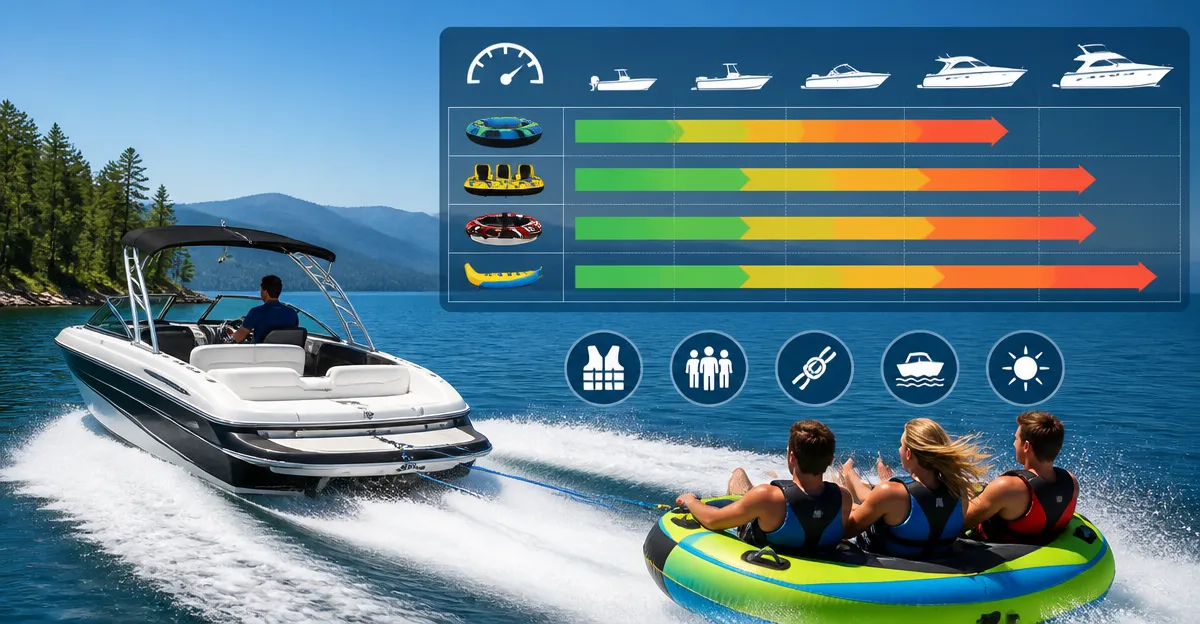
Towable Tube Speed Chart by Boat Horsepower: The Ultimate Guide to Safe, Optimal Speeds
Introduction
Water recreation enthusiasts often wonder how fast a boat should travel when towing an inflatable tube. This guide explains the relationship between boat horsepower and safe towable tube speed, provides a detailed speed chart, and recommends the best tubes for various power ranges. Readers will learn how to calculate optimal speeds, select a tube that matches their boat, and apply best‑practice safety tips. By the end of the article, one will be equipped to enjoy high‑energy tubing while minimizing risk.
Background and Context
Towable tubes rely on hydrodynamic forces generated by a motorized watercraft. The faster the boat moves, the greater the lift and drag on the tube, which can produce thrilling airtime but also increase the likelihood of loss of control. Horsepower (HP) is the most common metric used to describe a boat's power output, yet the actual speed achieved depends on hull design, weight, water conditions, and load. Understanding these variables allows an operator to set a speed that maximizes fun without compromising safety.
Key terms include:
- Bow Speed: The speed measured at the front of the boat, typically expressed in miles per hour (mph) or knots.
- Submarining: When a tube sinks beneath the water surface due to insufficient lift, a common issue at low speeds.
- Airtime: The period a rider spends airborne after the tube leaves the water’s surface, often desired by experienced tubers.
- Stability Index: A qualitative measure of how well a tube resists rolling or flipping at a given speed.
Manufacturers embed safety valves, reinforced handles, and specialized coatings to help riders stay on the tube across a range of speeds. The following sections break down optimal speed ranges, recommend specific products, and provide actionable best‑practice advice.
Speed Chart by Boat Horsepower
The chart below aligns typical boat horsepower with recommended bow speeds for towable tubes. Speeds are expressed in miles per hour (mph) and knots (1 knot ≈ 1.15 mph). These ranges assume a moderate load (1‑2 riders, total weight ≤ 340 lb) and calm to moderate water conditions.
| Boat Horsepower | Recommended Bow Speed (mph) | Recommended Bow Speed (knots) | Typical Tube Types |
|---|---|---|---|
| 5‑15 HP | 4‑6 | 3.5‑5.2 | Lightweight beginner tubes, e.g., RAVE Sports Razor Towable Tube |
| 15‑30 HP | 6‑9 | 5.2‑7.8 | Mid‑range tubes with reinforced handles, e.g., Airhead Comfort Shell Towable Tube |
| 30‑45 HP | 9‑12 | 7.8‑10.4 | High‑capacity tubes, e.g., Airhead Mable Towable Tube |
| 45‑60 HP | 12‑15 | 10.4‑13.0 | Performance‑oriented tubes, e.g., Airhead G-Force Towable Tube |
| 60‑80 HP | 15‑18 | 13.0‑15.6 | Heavy‑duty tubes for multiple riders, e.g., O'Brien Super Screamer Towable Tube |
Operators should always start at the lower end of the recommended range and increase speed gradually while monitoring rider comfort and tube stability. Adjustments may be required for wind, current, or additional passenger weight.
Product Recommendations by Power Range
Each tube featured in the speed chart possesses unique design elements that align with specific horsepower brackets. The following subsections describe why each product excels within its recommended range.
RAVE Sports Razor Towable Tube
Designed for small outboards (5‑15 HP), the RAVE Sports Razor Towable Tube offers a "Skim‑Fast" PVC‑coated bottom that generates lift at low speeds. Its 24‑gauge PVC bladder and 420D/600D nylon cover ensure durability, while four foam‑filled handles reduce hand fatigue. With a maximum rider weight of 340 lb, it is ideal for families with one or two children. The product holds a 4.7‑star rating from 529 reviews, confirming its reliability for beginners.
Airhead Comfort Shell Towable Tube
For medium‑power boats (15‑30 HP), the Airhead Comfort Shell Towable Tube features a turtle‑shaped shell that slices through water, providing stability at 6‑9 mph. Its 30‑gauge RF‑welded PVC bladder and plush neoprene foam deck protect riders from abrasions. The Kwik‑Connect tow system allows rapid attachment, and the patented Speed Safety Valve simplifies inflation. With a 4.6‑star rating from 989 reviews, users praise its comfort and smooth control.
Airhead Mable Towable Tube
When operating a 30‑45 HP boat, the Airhead Mable Towable Tube delivers ample capacity for two riders and optional three‑rider configurations. Double‑stitched nylon and EVA padding provide long‑term comfort, while the Kwik‑Connect tow system and Speed Safety Valve enable quick setup. Reviewers (4.4 stars from 6,944 reviews) highlight its stability at higher speeds and the ability to generate significant airtime without excessive risk.
Airhead G-Force Towable Tube
High‑performance boats (45‑60 HP) benefit from the Airhead G-Force Towable Tube. Its 30‑gauge virgin PVC bladder, 840‑denier double‑stitched nylon cover, and stabilizer fins keep the tube on the surface even at 12‑15 mph. Six deluxe handles with neoprene knuckle guards enhance grip during aggressive maneuvers. Although some users report occasional submarining, the overall 4.4‑star rating (2,723 reviews) confirms strong performance for thrill‑seekers.
O'Brien Super Screamer Towable Tube
For powerful boats (60‑80 HP) that can sustain 15‑18 mph, the O'Brien Super Screamer Towable Tube offers a robust 26‑gauge PVC bladder covered with 420‑denier nylon. Two oversized EVA deck pads and six EVA‑guarded handles provide comfort for up to two riders during high‑speed runs. The Lightning Valve inflates rapidly, and the Quick Connect tow system streamlines setup. With a 4.4‑star rating from 584 reviews, it is praised for durability and exhilarating rides.
Comparison and Selection Guide
Choosing the right towable tube depends on three primary factors: boat horsepower, rider capacity, and desired performance level. The table below summarizes each product’s strengths relative to these criteria.
| Product | Horsepower Range | Rider Capacity | Key Strength | Potential Drawbacks |
|---|---|---|---|---|
| RAVE Sports Razor | 5‑15 HP | 1‑2 | Lightweight, "Skim‑Fast" bottom for low‑speed lift | Limited to smaller boats |
| Airhead Comfort Shell | 15‑30 HP | 1‑2 | Comfortable neoprene deck, easy Kwik‑Connect | May feel "soft" at higher speeds |
| Airhead Mable | 30‑45 HP | 1‑3 | Versatile configurations, strong EVA padding | Heavier to transport |
| Airhead G-Force | 45‑60 HP | 1‑3 | Stabilizer fins, high‑speed stability | Occasional submarining if riders shift weight |
| O'Brien Super Screamer | 60‑80 HP | 2 | Robust 26‑gauge PVC, high‑speed durability | Higher price point |
When evaluating a tube, consider the maximum rider weight, the type of handles (foam‑filled vs. EVA‑guarded), and the presence of safety valves. A tube with a quick‑connect tow point simplifies rigging, especially for novice operators.
Best Practices & Tips for Safe Tubing
- Start Slow and Increment Speed Gradually. Begin at the low end of the recommended speed range, observe rider comfort, and increase by 0.5 mph increments.
- Check Boat Trim and Weight Distribution. An evenly loaded boat reduces bow lift fluctuations, which directly affect tube stability.
- Use a Dedicated Tow Rope. A rope with a shock‑absorbing loop (often sold as a "booster tube") reduces sudden tension spikes.
- Inspect Tubes Before Each Use. Verify that valves are fully closed, handles are intact, and the bladder shows no punctures.
- Educate Riders on Let‑Go Technique. If the tube becomes airborne, riders should release their grip to avoid whiplash, as highlighted in many user reviews of the Airhead Mable.
- Maintain a Safe Distance from Other Vessels. High‑speed tubing creates a larger wake; keep at least 50 ft from other boats to prevent collisions.
- Dress Appropriately. Long‑sleeve shirts, neoprene gloves, and water shoes protect skin from chafing and provide better grip on handles.
Applying these practices ensures that the excitement of tubing does not compromise safety. Remember that environmental factors—wind, current, and water temperature—can alter the optimal speed, so always reassess before each run.
Frequently Asked Questions
- What is the ideal speed for a 20 HP boat?
- For a 20 HP outboard, aim for a bow speed of 6‑8 mph (5‑7 knots). This range provides enough lift for most beginner tubes while keeping the risk of submarining low.
- Can I use a 30‑gallon pump to inflate a tube with a Speed Safety Valve?
- Yes. The patented Speed Safety Valve is compatible with standard electric or manual pumps. Users of the Airhead Mable report rapid inflation using a 120 V 2.5 psi pump.
- How many riders can the Airhead G-Force safely carry?
- The G‑Force is rated for 1‑3 riders. For three adult riders, ensure the total weight does not exceed the manufacturer’s limit (approximately 400 lb) and maintain speeds between 12‑15 mph.
- What maintenance is required for the RAVE Sports Razor?
- After each session, rinse the tube with fresh water, inspect the Boston valve for debris, and store it in a dry environment. The 24‑gauge PVC bladder resists UV degradation, but prolonged sun exposure can fade colors over years.
- Is a quick‑connect tow point necessary?
- A quick‑connect simplifies rigging and reduces the chance of tangled rope. All featured products include a quick‑connect system, making them suitable for both novice and experienced boaters.
- Do I need a separate tow rope for each tube?
- No. A high‑quality 12‑15 mm nylon rope with a looped end works for most tubes. However, larger tubes such as the O'Brien Super Screamer benefit from a thicker rope to handle increased load.
- What should I do if the tube starts to submarine?
- Immediately reduce speed and adjust rider positioning so weight is centered. Some tubes, like the Airhead G‑Force, include stabilizer fins that help correct this issue.
Conclusion
Understanding the interplay between boat horsepower and towable tube speed empowers boaters to deliver exhilarating yet safe experiences on the water. By following the speed chart, selecting a tube that matches the power range, and adhering to best‑practice safety guidelines, operators can minimize accidents while maximizing airtime and rider enjoyment. The featured products—RAVE Sports Razor, Airhead Comfort Shell, Airhead Mable, Airhead G‑Force, and O'Brien Super Screamer—represent the best options across low to high horsepower categories. Armed with this knowledge, one can confidently plan a day of tubing that balances thrill and responsibility.
Products Featured in This Guide
RAVE Sports Razor Towable Tube
Price: $109.99 | Rating: 4.7/5 (529 reviews)
Featured for its low‑power performance, "Skim‑Fast" bottom coating, and durable 24‑gauge PVC bladder, making it ideal for 5‑15 HP boats.
Airhead Comfort Shell Towable Tube
Price: $208.79 | Rating: 4.6/5 (989 reviews)
Featured for its plush neoprene deck, turtle‑shaped hull, and Kwik‑Connect system, providing smooth control for 15‑30 HP boats.
Airhead Mable Towable Tube
Price: $324.99 | Rating: 4.4/5 (6,944 reviews)
Featured for its versatile capacity (up to three riders), double‑stitched nylon cover, and EVA padding, suited for 30‑45 HP power ranges.
Airhead G-Force Towable Tube
Price: $254.99 | Rating: 4.4/5 (2,723 reviews)
Featured for its stabilizer fins, high‑speed stability, and robust 30‑gauge PVC bladder, making it perfect for 45‑60 HP boats.
O'Brien Super Screamer Towable Tube
Price: $219.95 | Rating: 4.4/5 (584 reviews)
Featured for its heavy‑duty 26‑gauge PVC bladder, oversized EVA deck pads, and Lightning Valve, catering to 60‑80 HP high‑performance boats.